Selling a house in Hermanus: is a higher price worth the wait?
By Simon Andrew | rare erf seller advisory
About the author: Simon Andrew is the founder of Rare Erf, a seller advisory service for property owners in Hermanus and the Overstrand. A property consultant for Fine & Country, the international real estate agency network specialising in upper-bracket properties, Simon brings over three decades of international marketing experience and a background in psychology and negotiation to his work. He helps sellers prepare, position and market their properties, make informed decisions and achieve the best possible outcome.
Should you accept a lower offer today or hold out for more?
The answer lies in what waiting costs, how credible the higher price is, and what the sale will allow you to do next.
You have an offer on your Hermanus home. Perhaps it is lower than you hoped, but the buyer appears serious. Your instinct is to wait because, surely, someone else will see what you see in your property and pay a little more?
They might. And sometimes, giving a well-priced property more time is exactly the right decision.
But it’s worth remembering that waiting has a price of its own. Bond interest, municipal charges, maintenance and missed investment opportunities can quietly consume the extra money you are hoping to gain.
The financial question is whether a realistically achievable higher price will leave you better off, even after you factor in the cost and risk of waiting.
Start by asking yourself: lower than what?
An offer below your asking price is not automatically below market value.
Your asking price is a proposal. Market value needs evidence: recent comparable sales, competing properties, buyer feedback and the conditions attached to actual offers.
What you paid, what you spent renovating, and what you need for your next purchase matter to your personal finances. They do not, by themselves, determine what a buyer will pay.
Before rejecting an offer, ask your agent to explain how it compares with recent sales of genuinely similar homes. Look at location, condition, views, plot size, accommodation and the date of sale. A renovated ocean-view home and a house needing substantial work can occupy the same suburb while competing for very different buyers.
For a selling decision, the useful question is narrower: “What is happening among buyers shopping for a property like mine, at my price?”
A premium home in Voëlklip or Fernkloof should not be priced simply by applying a town-wide average. Nor should a seller in Onrus or Sandbaai assume that a headline coastal sale establishes the value of their house.
A scarce property may justify patience. It can also have a smaller pool of buyers. And scarcity supports a higher price only when buyers value what is scarce.
What does holding out actually cost?
Start with the extra costs you would incur by selling later:
Bond interest and finance charges. Your full monthly repayment matters for affordability, but the capital portion reduces your debt and builds equity. Treating all of it as a permanent loss overstates the economic cost of waiting.
Rates, service charges and levies, where applicable.
Insurance, security, gardening, cleaning and maintenance, including a sensible allowance for unexpected repairs.
Costs of owning two properties, if you have already bought elsewhere.
Additional selling expenses, where extending the campaign involves costs you have agreed to pay.
Then consider what your money could do after the sale. Could it reduce another expensive loan, earn interest on the money market or help you secure your next home? The value you give up by delaying that use is an opportunity cost.
There are benefits to offset, too. If you still live in the house, selling sooner may mean paying rent or financing another home. If it earns rent, count the income after vacancies, management fees, maintenance and tax.
Compare the complete “sell sooner” and “sell later” positions. But be careful not to include expenses you would incur either way, i.e. regardless of whether you sell now or later, or count the same financing cost twice.
Also remember that accepting an offer does not put the proceeds in your account immediately. FNB explains that home-loan repayments continue during the bond cancellation process. Compare the likely dates when each transaction would complete and the money would become available.
A worked example: R200,000 more can leave you with less
Imagine you own an unbonded, vacant house in Hermanus. You have an offer of R4.8 million, but hope to achieve R5 million by waiting.
Assume the later sale would release your money six months after the earlier sale. For illustration:
Ownership costs during those extra months total R20,000 a month.
The agreed commission, including VAT, is 5.75% in either case. This is an example, not a prescribed rate.
The earlier sale would release R4,524,000 after commission, ignoring other selling costs for simplicity.
Those proceeds could earn a hypothetical 5% annual return after tax. This is an assumption, not a promised return.
There is no rent, no benefit from occupying the house, and no difference in other selling costs or capital gains tax.
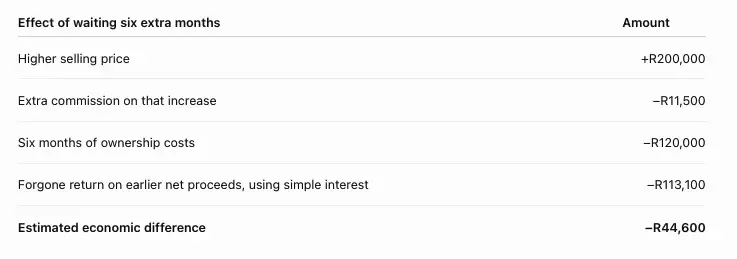
On these assumptions, the R5 million sale leaves you approximately R44,600 worse off economically than the R4.8 million sale completed earlier.
Without the opportunity cost, waiting would leave you R68,500 ahead. That difference shows why the use of your proceeds matters.
The approximate break-even price in this example is R5.05 million, allowing for commission on the increase. And reaching break-even gives you no reward for taking the risk that the higher offer never arrives.
Your own calculation may look very different. A house that provides your accommodation or produces reliable rental income may be far less expensive to hold.
When holding out can make sense
The offer is genuinely below a supported value range
Recent comparable sales may support a materially higher price. If the property has only just launched and several qualified buyers are arranging viewings, accepting an early low offer could be premature.
An early offer can sometime just be seen as useful information, rather than as a complete market verdict.
More time comes with a credible plan
Waiting is easier to justify when something specific will improve your prospects: completing a worthwhile repair, commissioning better photography, reaching a suitable buyer network, or allowing already interested buyers to view and make decisions.
The question is: what will change during the waiting period that could produce a significantly better result?
“Someone might pay more” is a possibility. A campaign with identified buyers and clear next steps is a plan.
You can comfortably afford the downside
A seller with low holding costs, flexible timing and adequate reserves has more room to negotiate. Patience can protect you from accepting an unnecessarily low offer under pressure.
But test your ability to carry the property if the campaign takes twice as long as expected, or if an expensive repair appears unexpectedly.
The likely gain comfortably exceeds the costs
Holding out is more persuasive when a supported higher price would cover ownership costs, additional selling costs and opportunity costs, with enough left over to justify the uncertainty and additional stress of waiting for a better price.
Small potential gains can disappear quickly. A larger, well-supported difference may warrant more time.
When holding out is harder to justify
Several credible buyers are telling you the same thing
One low offer may be opportunistic. Repeated offers around a similar level, after appropriate exposure, deserve closer attention.
So do consistent objections about condition, layout or price. Ask whether marketing is failing to explain the property’s value, or whether buyers understand it and still prefer alternatives.
Waiting is weakening your finances
If bond payments, two-property costs or declining savings are becoming uncomfortable, delay can reduce your future choices. You may eventually face greater pressure to accept a lower offer than the one available today.
Calculate the cost before your financial cushion becomes a deadline.
Your reason for waiting depends on a market prediction
Interest rates, competing stock and buyer confidence can change. A hoped-for improvement is uncertain, while your ownership costs are more predictable.
Seasonal visitor activity can be a reason to plan a campaign, but it does not guarantee good offers. Ask for evidence about completed sales and qualified buyers in your segment rather than assuming the next holiday period will solve the problem.
You could lose a worthwhile onward purchase
Your sale and your next purchase belong on the same page.
If accepting R150,000 less helps you buy your next home for R250,000 less, the combined price difference favours moving sooner by R100,000, before transaction costs and financing effects.
Conversely, your next home could become more expensive while you wait. Judge the whole move, including transfer costs, moving costs and any temporary accommodation you might need.
A higher offer is not always a better offer
Price is only one part of an offer’s value. Compare proof of funds, finance conditions, any requirement to sell another property, deadlines, occupation arrangements and the likely transfer timetable.
A lower offer with verified funding and manageable conditions may be more attractive than a higher offer that could collapse after months of waiting.
Cash buyers still require checks, and financed offers are not automatically weak. Ask your agent and conveyancer to assess the actual terms.
Capital Gains Tax (CGT) also affects what you keep. SARS provides exclusions for qualifying primary residences, but holiday homes, rental use and different ownership structures can change the treatment. Where relevant, have a tax adviser compare the net proceeds under each option.
Give patience a budget and a review date
Before rejecting a credible offer, agree five things with your agent:
A supported price range, based on comparable sales and current competition.
Your monthly cost of delay, allowing for accommodation benefits or net rent.
A realistic campaign period, appropriate to your property and buyer pool.
A review date, when you assess enquiries, viewings, offers and competing stock.
A response to disappointing results, such as improving presentation, changing the campaign or adjusting the price.
Then examine three possible outcomes: a better price, a similar price after a longer wait, and a lower price after further costs. Could you live with each?
A prolonged listing can invite questions about price or condition, although a long selling period does not automatically mean either is wrong. A rare property may need time. What matters is whether the evidence still supports the strategy.
Aim for the best outcome you can actually keep
You deserve advice that respects both the value of your home and the cost of your time. That means questioning an unnecessarily low offer and questioning an optimistic price that lacks evidence.
Hold out when the higher price is credible, you can afford the wait, and the likely gain rewards the risk. Consider selling sooner when a sound offer supports your wider plans and delay is likely to consume the difference.
A good selling decision protects the money you keep and the choices it gives you.
Need help making the decision?
If you are considering selling in Hermanus or the surrounding Overstrand area, contact Simon Andrew at Rare Erf to discuss how best to plan for the upcoming sale.